
The short answer: for fermenting shredded cabbage and similar vegetables, weigh your salt rather than measuring it with a spoon. A widely used home ratio is about 2% salt to the weight of the vegetables, which means roughly 20 g of salt for every 1 kg of cabbage. Keep everything under its own brine, ferment somewhere comfortably cool, and follow a tested recipe.
Of the few ingredients in a vegetable ferment, salt is the one people most often get wrong, especially when switching from fine table salt to a coarse, naturally moist sea salt. This guide explains what salt actually does in a ferment, how to work out the right amount, and what to keep in mind when you use an unrefined grey sea salt.
What salt does in a vegetable ferment
When you massage salt into shredded cabbage, the salt draws water out of the leaves. Within a short time the cabbage sits in its own liquid, the brine. That brine keeps air away from the vegetables and creates the salty, oxygen-poor conditions in which lactic acid bacteria naturally present on the cabbage can take over.
The fermentation of sauerkraut happens in stages. Different groups of bacteria lead at different times, including Leuconostoc mesenteroides early on and Lactobacillus species such as L. brevis and L. plantarum later. They turn the natural sugars in the cabbage into acids, which give fermented vegetables their sour taste.
Salt therefore matters for three things:
- Brine: enough salt pulls enough juice from the vegetables to cover them.
- Texture: salt helps the vegetables stay crisp rather than soft.
- Flavour: too little tastes flat, too much makes the result harsh and can slow the ferment.
How much salt to use: weigh it
The simplest reliable method is to weigh the prepared vegetables first and then calculate the salt as a percentage of that weight.
A worked example
- Remove the outer leaves and the core, then shred the cabbage.
- Put a large bowl on the kitchen scale, set it to zero and add the cabbage. Say it weighs 1,500 g.
- Multiply by 0.02: 1,500 × 0.02 = 30 g of salt.
- Sprinkle the salt over the cabbage and massage it with clean hands for several minutes until the leaves soften and liquid collects in the bowl.
For comparison, the US National Center for Home Food Preservation (NCHFP) gives its tested sauerkraut procedure in volume: 3 tablespoons of canning or pickling salt per batch of about 5 lb (2.3 kg) of cabbage. A 2% weight ratio is in the same range, and working by weight has one big advantage: it does not depend on the size or moisture of your salt crystals.
Why spoons do not work well for coarse sea salt
A tablespoon of fine, dry table salt and a tablespoon of coarse, moist grey sea salt do not weigh the same. Large crystals leave air gaps in the spoon, and naturally moist salt carries a little sea water with it. If a recipe gives spoon measures written for fine salt, convert it to grams or simply use the 2% rule with a scale.
Using unrefined sea salt for fermenting
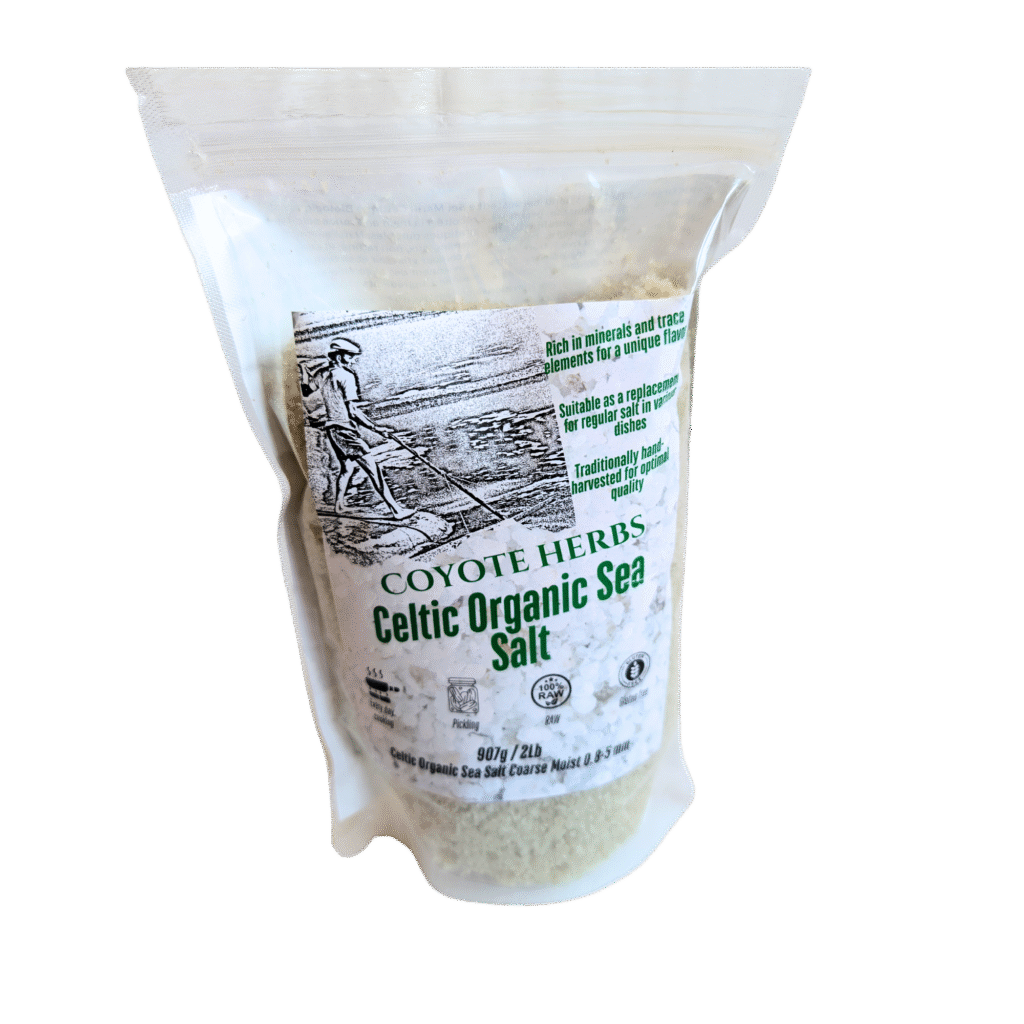
Our Celtic Sea Salt is a coarse grey salt that is sold in its natural, moist state, with no bleaching, no anti-caking agents and no other additives. Because nothing is added to keep it free-flowing, the ingredient list of your ferment stays exactly as short as you planned: vegetables and salt.
A few practical points when fermenting with this kind of salt:
- Weigh it. As explained above, this is the key difference compared with fine salt.
- Crush large crystals if you like. Coarse crystals dissolve more slowly on dry shredded cabbage. Grinding them briefly in a mortar, or dissolving them in a little of the vegetable juice, spreads the salt more evenly.
- Expect a slightly greyer brine. Grey sea salt takes its colour from the clay of the salt marshes where it is harvested, so a little of that colour can show in the liquid. This is a matter of appearance.
- Keep the salt dry between uses. A moist salt clumps if it is left open or touched with a wet spoon. Our guide to why grey sea salt is moist and how to store it explains how to keep it loose.
Note that tested recipes such as the NCHFP procedure are written for canning or pickling salt. If you use any other salt, follow the recipe’s weights and method as closely as you can.
Step by step: a simple salted cabbage ferment
- Clean everything. Wash the jar or crock, the weight and your hands well.
- Shred and weigh the cabbage. In Lithuania, fermented cabbage (rauginti kopūstai) is often made with shredded carrot as well; add the carrot weight to the total before calculating salt.
- Salt and massage until there is visible brine in the bowl.
- Pack tightly into the jar, pressing each layer down so the brine rises above the vegetables. Leave space at the top.
- Weigh it down. Use a clean glass weight, a smaller jar, or a food-safe bag filled with brine so everything stays submerged.
- Top up if needed. If the vegetables do not make enough juice, NCHFP suggests a brine of 1½ tablespoons of salt per quart (about 0.95 litre) of boiled and cooled water.
- Cover loosely so gas can escape, and place the jar on a tray in case brine overflows.
Temperature and time
Temperature has a big influence on the result. According to the NCHFP sauerkraut guidance:
- at 21–24 °C (70–75 °F) kraut is fully fermented in about 3 to 4 weeks;
- at 15–18 °C (60–65 °F) it takes about 5 to 6 weeks;
- below about 15 °C (60 °F) it may not ferment;
- above about 24 °C (75 °F) it may become soft.
A cool corner of the kitchen or a pantry usually works better than a spot near a radiator. Check the jar two or three times a week, press the vegetables back under the brine, and skim off any surface scum, as the NCHFP procedure advises.
When not to eat a ferment
Home fermentation relies on clean equipment, the right amount of salt and vegetables kept under the brine. If you see fuzzy or coloured mould growing into the vegetables, the texture turns slimy, or the jar smells unpleasant rather than cleanly sour, do not taste it. When in doubt, throw it out and start again with a fresh batch.
You will find our sea salt and other pantry items in the Grocery category, or you can browse the whole shop. Delivery within Lithuania is free.
Frequently asked questions
How much salt do I need to ferment cabbage?
A common home ratio is about 2% of the vegetable weight, around 20 g of salt per 1 kg of shredded cabbage. The NCHFP tested procedure uses 3 tablespoons of canning or pickling salt for about 5 lb (2.3 kg) of cabbage.
Can I use grey or Celtic sea salt for fermenting vegetables?
Many home cooks do. Because coarse, moist sea salt weighs differently from fine salt, weigh it instead of using spoon measures. Tested recipes are written for canning or pickling salt, so follow their weights and method closely.
Why should I weigh salt instead of using a spoon?
Crystal size and moisture change how much salt fits in a spoon. Weighing gives the same ratio every time, whatever salt you use.
What temperature is best for fermenting cabbage?
According to the NCHFP, kraut ferments in about 3 to 4 weeks at 21–24 °C and in about 5 to 6 weeks at 15–18 °C. Below about 15 °C it may not ferment, and above about 24 °C it may become soft.
What if there is not enough brine to cover the cabbage?
Press the cabbage down firmly and wait a little. If it is still not covered, add a brine of 1½ tablespoons of salt per quart (about 0.95 litre) of boiled and cooled water.
Why is my brine slightly grey?
Grey sea salt contains a little clay from the salt marshes where it is harvested, and some of that colour can show in the brine. It affects appearance only.
Please note: this article is general culinary information. Salt and fermented vegetables are foods, not medicines, and this is not medical or dietary advice. If you are pregnant, breastfeeding, taking medication or have been advised to limit your salt intake, consult a doctor before changing your diet. Always follow a tested recipe and good kitchen hygiene.
Sources
- National Center for Home Food Preservation, Sauerkraut (salt amounts, brine, temperatures and fermentation times)
- Wikipedia, Sauerkraut (fermentation stages, bacteria, Lithuanian name)
- Product information for our Celtic Sea Salt (unrefined, no anti-caking agents, no additives)