
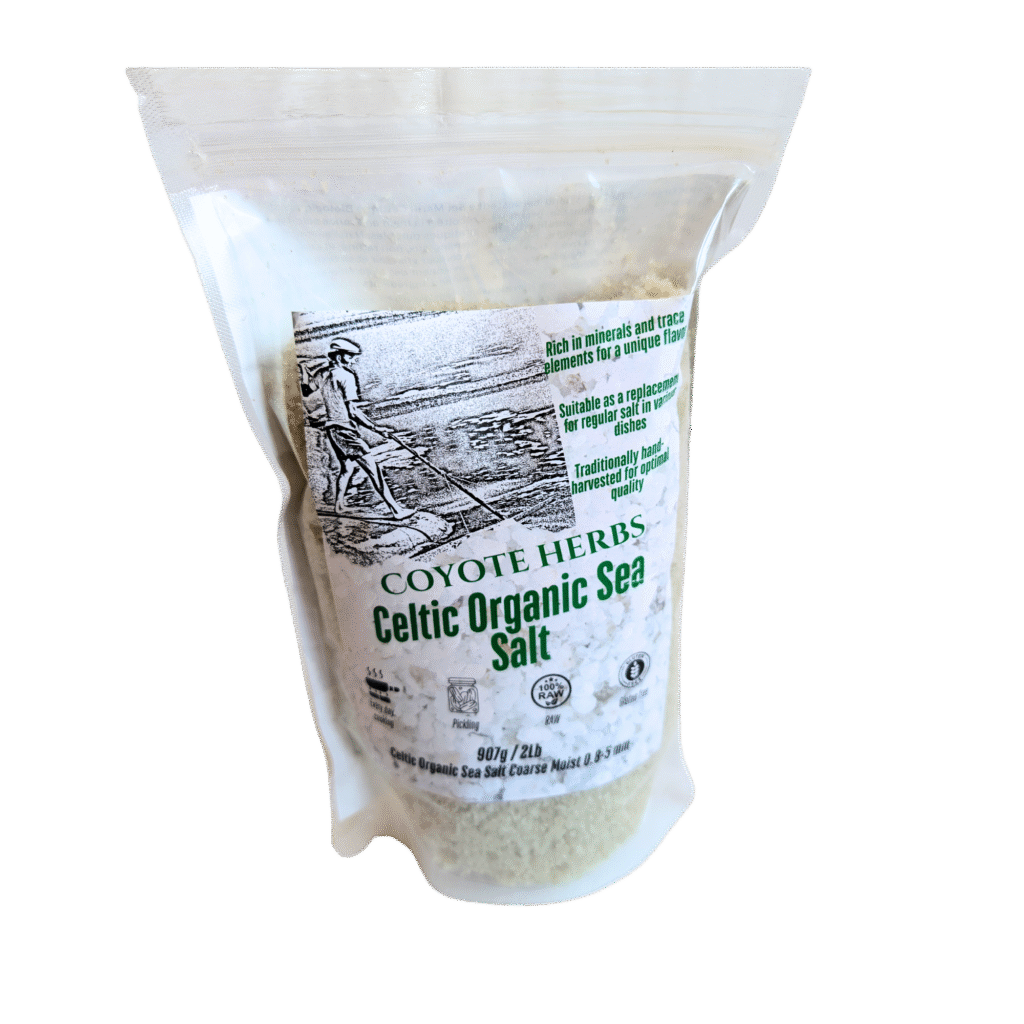
Grey sea salt (sel gris) is moist and grey because of how it is made: it crystallises in shallow, clay-lined salt pans on the French Atlantic coast and is raked from the bottom of the pan, so it keeps some natural moisture and picks up a faint grey tint from the clay. That moisture is normal, not a defect. With the right container, grey sea salt stays loose, clean-tasting and easy to use for years.
This guide explains where grey sea salt comes from, how it differs from fleur de sel and fine table salt, how to judge its quality by eye and touch, and how to store it so it does not clump or dry into a hard block.
What is grey sea salt (sel gris)?
Sel gris is simply French for “grey salt”. It is a coarse, unrefined sea salt produced by solar evaporation in traditional salt marshes. The best-known sources are the marshes of Guérande in Loire-Atlantique, along with the islands of Île de Ré and Noirmoutier further down the coast. In English-speaking shops the same style of salt is also sold as “Celtic-style” or “Breton” sea salt, a reference to the region’s Celtic heritage.
Our own unrefined Celtic sea salt from Guérande belongs to this family: hand-harvested, not washed or bleached, and sold without anti-caking agents.
The Guérande salt marshes
The Guérande peninsula has a very long history of salt-making. According to France’s official tourism site, salt was gathered there as early as the Iron Age, the first salt pans date from the 3rd century, and the present outline of the marshes goes back to the 10th century. Today the marshes cover more than 2,000 hectares.
In 2012 the European Union registered “Sel de Guérande / Fleur de sel de Guérande” as a Protected Geographical Indication (PGI), which ties the name to the place and to its traditional production method.
How grey sea salt is harvested
The salt workers of Guérande are called paludiers, from the Latin palus, meaning marsh. Their year follows the seasons:
- Spring: pans are drained of rainwater and cleaned of silt and algae.
- Summer: seawater flows slowly through a series of shallow basins. Sun and wind evaporate the water until salt crystals form. This is harvest season.
- Autumn: the marshes are protected from high tides and frost.
- Winter: the basin floors are repaired ready for the next year.
Coarse grey salt forms at the bottom of the final crystallising pans. Every day or every few days, the paludier pushes it to the edge of the pan with a long wooden rake, taking care not to break the clay floor, and piles it up to drain before storage. Because the salt is gathered from the bottom rather than skimmed from the surface, it carries a little of the fine clay and its natural moisture with it.
Why is grey sea salt moist and grey?
Two things give sel gris its character:
- Colour. The crystals sit in contact with the clay floor of the pan before raking. That contact gives them their light grey tone. The shade varies from batch to batch and pan to pan, and that variation is expected in a natural product.
- Moisture. Grey salt is not kiln-dried. It typically keeps around 13% residual moisture, which is why it feels slightly damp and clings together a little when you pinch it. It is not wet because something went wrong in transit; it is meant to be that way.
The moisture also explains a practical point for cooks: because the crystals are dense and slightly damp, a spoonful of grey salt does not weigh the same as a spoonful of fine table salt. If you are switching between salts, season by taste rather than by volume.
Grey sea salt vs fleur de sel vs fine salt
The same marshes produce more than one kind of salt, and they are easy to confuse:
| Type | How it is made | Look and feel | Typical kitchen use |
|---|---|---|---|
| Coarse grey salt (gros sel) | Raked from the bottom of the pan | Large, irregular, grey, slightly damp crystals | Cooking water, brines, salt crusts, a salt grinder or mortar |
| Fine grey salt | Coarse grey salt that has been dried, crushed and sieved | Small grains, pale grey, drier | Everyday seasoning, baking, the table |
| Fleur de sel | Skimmed by hand from the surface of the water in calm, warm weather | Thin, flaky, naturally white crystals | Finishing salt sprinkled on just before serving |
Fleur de sel is gathered in much smaller quantities than grey salt, which is why it is usually more expensive. Neither is “better”; they simply do different jobs in the kitchen.
How to recognise good-quality grey sea salt
You do not need a laboratory to judge a bag of sel gris. Look for these signs:
- Uneven crystals. Hand-raked salt has irregular crystal sizes and shapes. Perfectly uniform cubes suggest a refined or reprocessed salt.
- A natural, uneven grey. Expect soft grey to off-white tones that vary slightly through the bag. Bright white coarse salt is usually a different product.
- Slight dampness. Crystals should feel a little moist and clump lightly in your fingers, then crumble apart easily.
- A clean, sea-like smell. It should smell faintly of the sea and nothing else. A musty, sour or chemical smell is a sign of poor storage.
- A short ingredients list. The label should say sea salt and nothing more: no anti-caking agents, no added iodine or flavourings unless clearly stated.
- Clear origin. A named region (for example Guérande) and, where used, the PGI wording on the pack give you a way to trace where the salt comes from.
Tiny dark specks of clay are normal in unwashed grey salt. Larger bits of debris such as fibres or grit are not, and should be reported to the seller.
How to store grey sea salt so it stays loose
Salt does not go off in the way fresh food does, but it readily absorbs and releases moisture from the air. Good storage is about keeping that exchange under control.
Choose the right container
- Glass, glazed ceramic or food-grade plastic with a well-fitting lid all work well.
- Avoid bare metal tins and metal lids that touch the salt. Moist salt can corrode metal over time and discolour the crystals.
- A traditional salt pig or salt box (an open-fronted ceramic or wooden pot) is handy beside the hob for daily use, but keep the bulk of your supply in a sealed jar.
- Once opened, a resealable pouch is fine if you press out the air and close it fully after each use.
Pick the right spot
- Store it somewhere cool, dry and out of direct sunlight, such as a cupboard away from the cooker and kettle.
- Do not keep the main jar directly above the hob or next to the dishwasher, where steam will make it clump.
- There is no need to refrigerate salt; the fridge is a humid place and can make clumping worse.
If it clumps or dries out
- Clumped salt: break it up with a clean, dry spoon or give the sealed jar a firm shake. A few grains of uncooked rice in a separate small salt shaker can help with fine salt, but keep rice out of the main jar.
- Salt that has gone dry and hard: it is still perfectly usable as salt. Crush it in a mortar or salt grinder. If you prefer the damp texture, keep the next batch better sealed.
- Grinders: moist grey salt can jam some grinders. Use a ceramic-mechanism grinder designed for moist salt, or let a small portion air-dry on a plate for a day before filling the grinder.
Always use a dry spoon
The easiest way to keep any salt in good condition is never to put a wet spoon or wet fingers into the jar. Water from the spoon is what starts most clumps.
Using grey sea salt in the kitchen
Grey sea salt is valued by cooks for its crunchy texture and rounded, mineral taste. A few classic uses:
- Salting pasta and vegetable cooking water.
- Making brines and dry cures for vegetables, fish or meat.
- Baking whole fish or vegetables in a salt crust.
- Lacto-fermenting vegetables such as cabbage, where an unrefined salt without anti-caking agents is a common choice.
- Grinding fresh over roasted vegetables, salads and grilled food.
As with any salt, use it to taste. You can browse other pantry staples in our Grocery category or see the full Coyote Herbs shop.
Frequently asked questions
Is it normal for grey sea salt to be damp?
Yes. Grey sea salt is not kiln-dried and typically keeps around 13% residual moisture. A slightly damp feel and light clumping are normal for this type of salt.
Why is grey sea salt grey?
It is raked from the bottom of clay-lined salt pans, and contact with the clay floor gives the crystals their natural grey colour. The shade can vary between batches.
What is the difference between sel gris and fleur de sel?
Sel gris is coarse salt raked from the bottom of the pan. Fleur de sel is a thin layer of fine, white, flaky crystals skimmed by hand from the water’s surface in calm weather, and is mostly used as a finishing salt.
How should I store grey sea salt?
Keep it in a sealed glass, ceramic or food-grade plastic container in a cool, dry cupboard away from steam and direct sunlight. Avoid bare metal containers and always use a dry spoon.
Does grey sea salt expire?
Salt itself does not spoil, but its texture can change if it absorbs or loses moisture. Follow the best-before date on the pack and keep it sealed to preserve its texture and clean taste.
Please note: This article is general information about the origin, culinary use and storage of sea salt. Not a medicine; not intended to diagnose, treat, cure or prevent any disease. Follow the label and any instructions on the pack.
Sources
- France.fr (official French tourism site), 5 minutes pour tout savoir sur le sel de Guérande
- Commission Implementing Regulation (EU) No 238/2012, registration of “Sel de Guérande / Fleur de sel de Guérande” (PGI)
- Wikipedia, Sel gris