
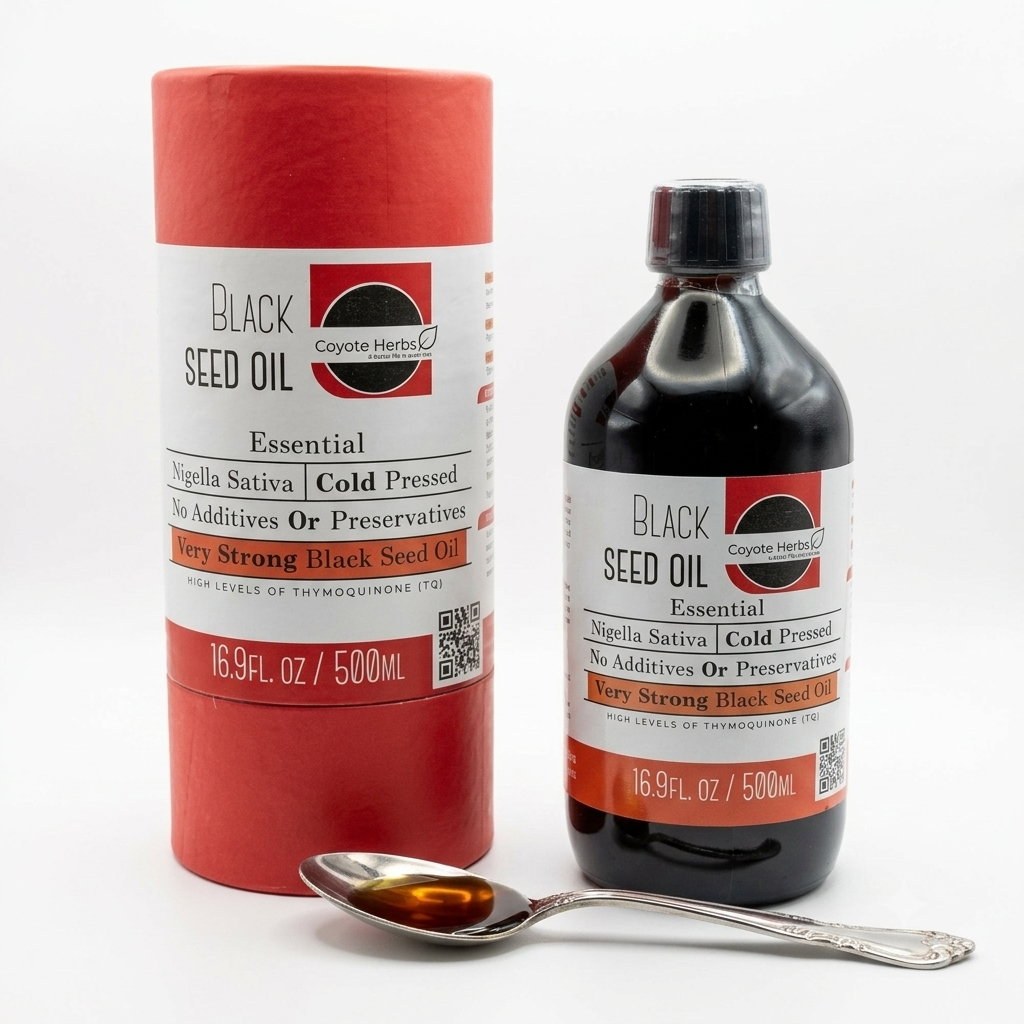
The short answer: keep black seed oil in its dark glass bottle, tightly closed, upright, in a cool and dark cupboard away from the stove, windows and bathroom steam. Light, heat and air are the three things that age a cold-pressed oil fastest. Unfiltered oil will also form a dark sediment at the bottom, which is normal. Shake the bottle gently before each use.
This guide covers where black seed oil comes from, what the plant Nigella sativa actually is (and what it is often confused with), how to tell a fresh bottle from a tired one, and how to store it so it keeps its colour and its peppery aroma.
What is Nigella sativa?
Nigella sativa is a small annual flowering plant in the buttercup family, Ranunculaceae. It usually grows to around 20–30 cm tall, with finely divided, almost feathery leaves and delicate pale blue or white flowers with five to ten petals. After flowering it forms a swollen seed capsule made of several fused sections, each packed with small, angular, matt black seeds.
The plant is native to an area stretching from south-eastern Europe (Bulgaria and Romania) into Western Asia, and today it is grown much more widely, from North Africa to South Asia. The genus name Nigella is a diminutive of the Latin niger, “black”, a reference to the seeds. The species name sativa simply means “cultivated”.
Our own raw, unfiltered black seed oil is cold-pressed from Nigella sativa seeds grown in Bangladesh and bottled in amber glass.
One plant, many names
Few plants have as many common names as Nigella sativa. Depending on the country and the shop, you may see it sold as:
- Black seed or black cumin
- Black caraway
- Kalonji (common in South Asian shops)
- Charnushka (Eastern Europe)
- Fennel flower, nutmeg flower or Roman coriander
- Black onion seed, even though it has nothing to do with onions
What it is often confused with
Because the names overlap, it is easy to buy the wrong thing. “Black cumin” and “black caraway” are also used for Bunium species (for example Bunium bulbocastanum and Elwendia persica, also known as Bunium persicum), which belong to the carrot family and have long, ridged seeds. True nigella seeds are small, angular and three-sided, more like tiny chips of black stone. Black sesame seeds are another look-alike, but they are flat, teardrop-shaped and glossy.
When buying seeds or oil, the safest check is the botanical name on the label: it should say Nigella sativa.
A very old plant
Nigella has been cultivated for roughly three thousand years. Seeds have been found at several ancient Egyptian sites, including the tomb of Tutankhamun, and in a Hittite flask in Turkey dating to the second millennium BC.
The seeds are also a long-standing spice in many kitchens. They are one of the five seeds in the Bengali mix panch phoron, they are scattered on some flatbreads such as Persian nân-e barbari, and they are used in the braided Middle Eastern cheese known as majdouleh. That culinary history concerns the whole seeds as a spice. Our black seed oil is sold as a cosmetic raw material for external use, not as a food.
What is in a bottle of cold-pressed black seed oil?
“Cold-pressed” means the seeds are pressed mechanically without added heat or chemical solvents. The oil that comes out is dark amber to brownish, with a strong, spicy and slightly bitter aroma that many people describe as peppery.
Why unfiltered oil has sediment
Unfiltered oil is bottled without a final fine filtration, so tiny particles from the pressed seed stay in the oil. Over days and weeks they settle as a darker layer at the bottom of the bottle. This is expected and does not mean the oil has gone off. A gentle shake before use mixes it back in.
Thymoquinone and light
One of the best-known natural compounds in nigella seed oil is thymoquinone, which contributes to its characteristic sharp aroma. Laboratory work has shown that thymoquinone is very sensitive to light: a 2014 study in the journal Molecules (Salmani et al.) found that even short light exposure caused severe degradation of thymoquinone in solution, and that it was also less stable at alkaline pH. That is one of the main reasons good black seed oil is sold in dark glass, and why keeping the bottle out of light matters.
How to tell if black seed oil is fresh
You do not need a lab to judge a bottle. Use your eyes and nose:
- Colour: fresh unfiltered oil is dark amber to brown. A sudden, noticeable change compared with when you opened it is a warning sign.
- Aroma: it should smell spicy, warm and peppery. A sour, paint-like, crayon-like or “old nuts” smell suggests the oil is going rancid.
- Texture: it should feel like a normal liquid oil at room temperature. Stickiness or a gummy film around the neck of the bottle points to oxidation.
- Sediment: a dark layer at the bottom is normal for unfiltered oil. Mould, floating fuzzy spots or an unusual cloudiness at room temperature are not.
- Packaging: look for dark amber or other light-blocking glass, a tight cap and a best-before date.
If the oil smells clearly rancid, do not use it.
How to store black seed oil: 7 practical rules
- Keep it in the original dark glass bottle. Amber glass blocks much of the light that damages the oil. Do not decant it into a clear bottle for display.
- Choose a dark cupboard. A closed cupboard or drawer is better than an open shelf, even in a room that seems dim.
- Keep it cool. Avoid spots next to the cooker, oven, radiator, dishwasher or a sunny window sill. Normal cool room temperature is fine.
- Avoid steam and humidity. A steamy bathroom cabinet is not ideal. If you use the oil in a bathroom routine, store the main bottle elsewhere.
- Close the cap straight after use. Oxygen slowly oxidises oils. The less time the bottle stands open, the longer it stays fresh.
- Store it upright and keep the neck clean. Wipe drips from the thread of the bottle so the cap seals properly and no sticky film builds up.
- Use clean, dry tools. If you transfer oil with a dropper or spoon, make sure it is clean and dry. Water and debris shorten the life of an oil.
Can you keep it in the fridge?
Yes, you can. Refrigeration slows oxidation, which is useful in a warm home. The oil may thicken or turn slightly cloudy in the cold. This is a physical effect, not spoilage, and it clears once the bottle returns to room temperature. Take it out a little before you need it and keep the cap closed so condensation does not get inside.
Large or small bottles?
Every time a bottle is opened, a little more air reaches the oil. If you use black seed oil only occasionally, a smaller bottle that you finish within its best-before period is often a better choice than a large one that stays half empty for months. If you prefer a larger size, keep it sealed in a cool, dark place and decant only what you need into a small dark bottle for daily use.
How long does black seed oil keep?
Shelf life depends on how fresh the oil was when bottled and how it is stored, so always follow the best-before date on the bottle. Treat that date as the guideline for an unopened, properly stored bottle. Once opened, the storage rules above make the real difference, and your nose remains the best everyday test.
Black seed oil is also part of our Core Elements Bundle, and you can browse other raw botanical ingredients in our Pure Botanical & Topical Raw Materials category. For another storage guide, see our article on how to store grey sea salt.
Frequently asked questions
What is the best way to store black seed oil?
Keep it in its original dark glass bottle, tightly closed and upright, in a cool, dark cupboard away from heat, sunlight and steam.
Is the sediment in black seed oil normal?
Yes. Unfiltered black seed oil contains fine particles from the pressed seeds that settle at the bottom. This is normal. Shake the bottle gently before use.
Why is black seed oil sold in dark bottles?
Light speeds up the ageing of oils, and laboratory research has shown that thymoquinone, one of the characteristic compounds in nigella seed oil, degrades quickly when exposed to light. Dark glass helps protect it.
How can I tell if black seed oil has gone rancid?
Fresh oil smells spicy and peppery. A sour, paint-like or stale smell, a sticky film or a clear change in colour suggest the oil has oxidised and should not be used.
Is black cumin the same as Nigella sativa?
Not always. The name black cumin is a common name for Nigella sativa, but it is also used for Bunium species, which are different plants. Check the botanical name on the label.
Please note: This article is general information about the botany, history and storage of black seed oil. Our black seed oil is sold as a cosmetic raw material for external use only. Not a medicine; not intended to diagnose, treat, cure or prevent any disease. Follow the label and any instructions on the pack, and keep out of reach of children.
Sources
- Salmani J.M.M., Asghar S., Lv H., Zhou J. (2014). Aqueous Solubility and Degradation Kinetics of the Phytochemical Anticancer Thymoquinone; Probing the Effects of Solvents, pH and Light. Molecules, 19(5), 5925–5939.
- Wikipedia, Nigella sativa