
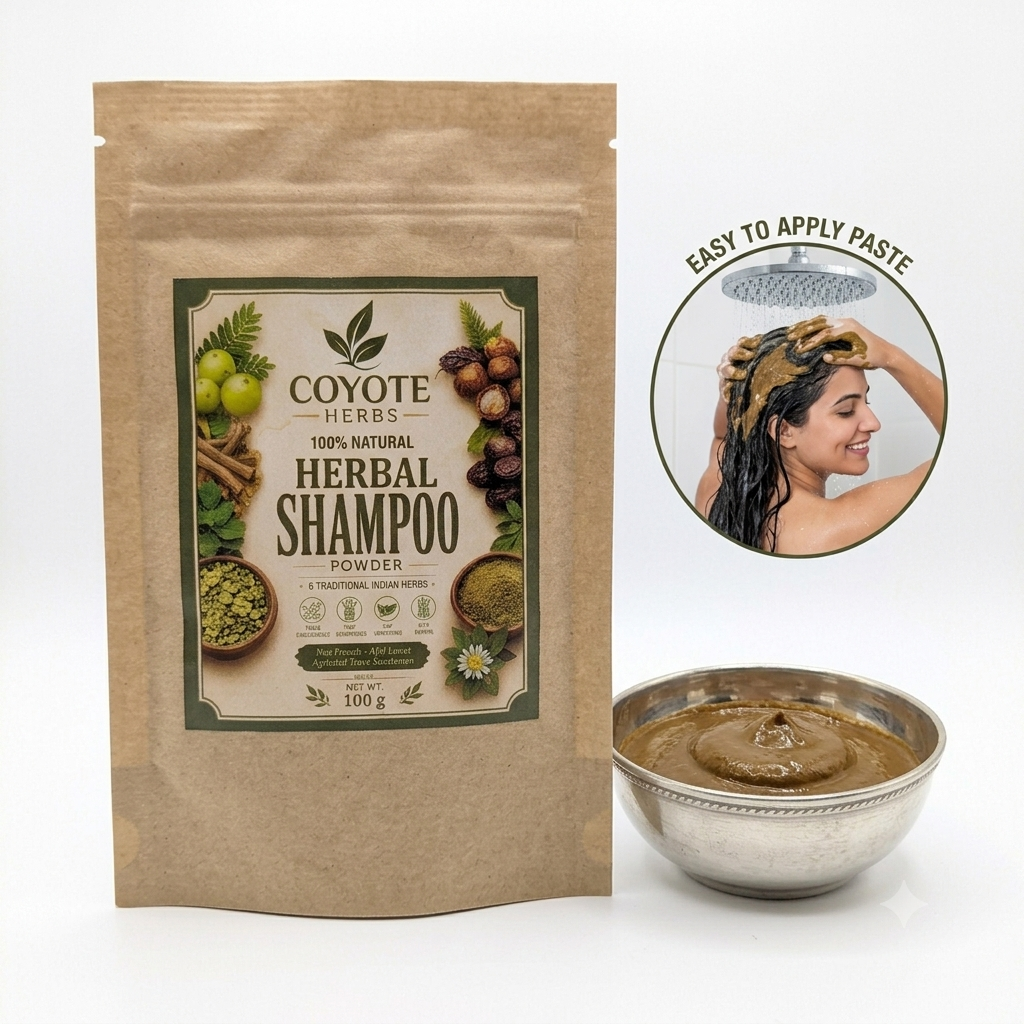
The short answer: mix 2–3 teaspoons of powder with warm water in a non-metallic bowl until it looks like smooth yoghurt, let it rest for 10–15 minutes, then massage it into wet hair at the roots and rinse very thoroughly. A powder shampoo makes far less foam than a liquid one. That is normal, and it does not mean it is not working.
Powder shampoos are one of the oldest ways of washing hair, yet for most people used to a plastic bottle they feel unfamiliar at first. This guide explains what is actually in a traditional Ayurvedic-style powder, how to mix and apply it step by step, how to rinse it out cleanly and how to store the dry powder so it stays fresh.
What is an Ayurvedic powder shampoo?
An Ayurvedic powder shampoo is simply a blend of dried, finely ground plant parts that you mix with water yourself just before washing. There is no water, no synthetic foaming agent and no preservative in the pack, because it only becomes a paste in your bowl.
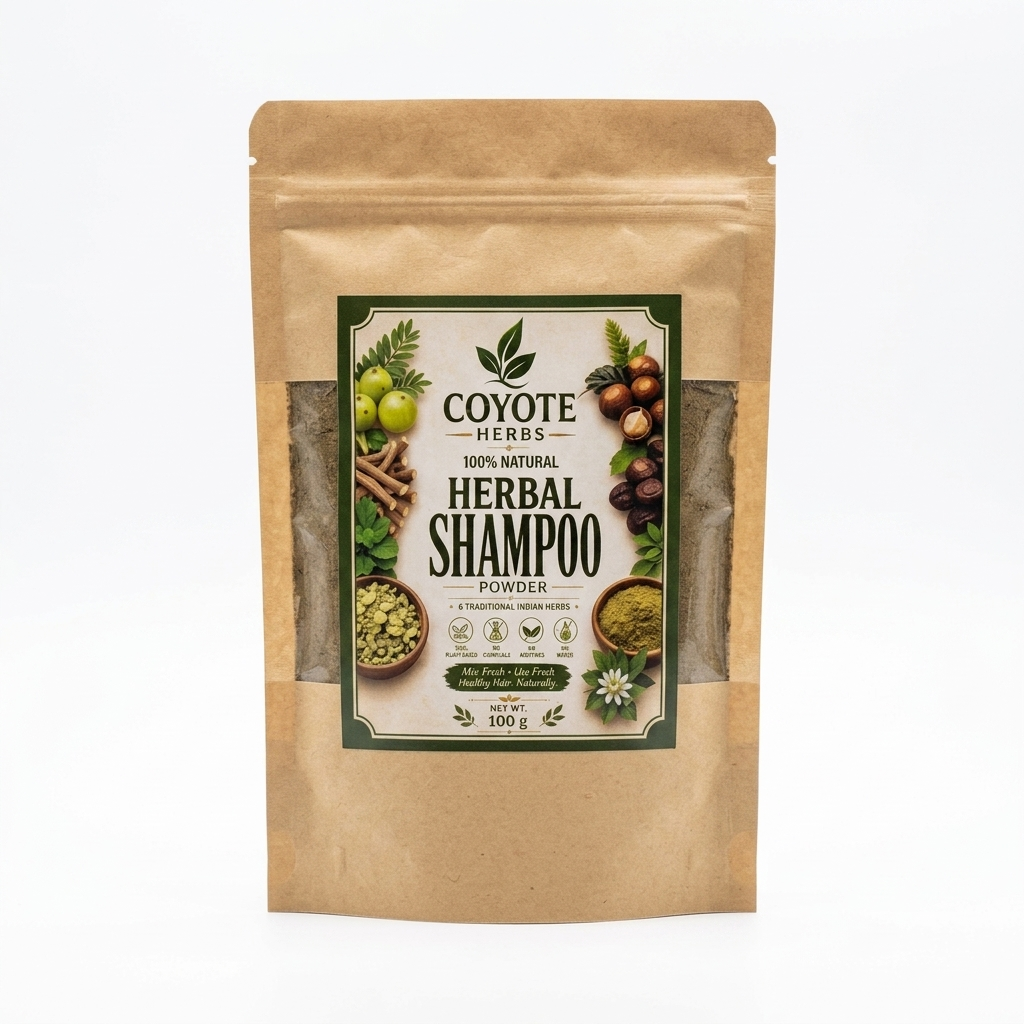
Our Ayurvedic Powder Shampoo & Hair Mask is a 100 g blend of six botanicals, formulated and packed in Poland. You will find it in our Hair Care: Shampoo & Hair Masks category.
Where the word “shampoo” comes from
The word itself has Indian roots. It entered English in the 18th century from the Hindi chāmpo, from a verb meaning “to press” or “to knead”, originally describing a head massage rather than a liquid product. In 1814 Sake Dean Mahomed opened a “shampooing” vapour bath in Brighton, which helped make the word familiar in Britain. Washing hair with plant powders and pods, such as soapnut and shikakai, has a long tradition in the Indian subcontinent.
The botanicals in a traditional blend
Different brands use different recipes. These are the six plants listed on our pack, with a little botany for each:
- Soapnut, reetha or aritha (Sapindus mukorossi, soapberry family Sapindaceae). A tree from the Himalayan foothills whose dried fruit shells contain saponins, natural plant compounds that form a light lather in water. Soapnut shells have also long been used for washing clothes.
- Shikakai (Acacia concinna, legume family Fabaceae). A thorny climbing shrub of South and Southeast Asia. Its dried pods are ground into a brownish powder that is a classic ingredient of traditional hair-washing mixes.
- Fenugreek (Trigonella foenum-graecum, Fabaceae). Better known as a kitchen spice. When the ground seed meets water it becomes noticeably slippery, which gives the paste a smoother feel.
- Neem (Azadirachta indica, mahogany family Meliaceae). A fast-growing evergreen tree from the Indian subcontinent. Its dried leaves add a green colour and a typical herbal, slightly bitter scent.
- White turmeric or zedoary (Curcuma zedoaria, ginger family Zingiberaceae). A relative of common turmeric, with a paler rhizome and an earthy, camphor-like aroma.
- Sidr (Ziziphus spina-christi, buckthorn family Rhamnaceae). A tree of North Africa and the Middle East whose powdered leaves are a traditional hair-washing ingredient in that region.
Together these give the paste its earthy green-brown colour, its herbal smell and its creamy, slightly slippery texture.
How to use powder shampoo, step by step
- Measure. Put 2–3 teaspoons of powder into a small bowl. Use a little more for long or very thick hair, a little less for short hair. A glass, ceramic or wooden bowl and spoon work best; the instructions on our pack recommend a non-metallic bowl.
- Add warm water gradually. Pour in warm (not hot) water, around 40–50 °C, a little at a time, stirring as you go, until the paste has a smooth, yoghurt-like consistency. Too thick and it will not spread; too thin and it will run.
- Let it rest. Leave the paste for 10–15 minutes. The powder needs this time to absorb the water fully, and the texture becomes smoother and more slippery.
- Wet your hair well. Hair should be thoroughly wet, not just damp at the ends.
- Apply at the roots. Work the paste section by section onto the scalp and roots with your fingertips. Let the paste run through the lengths as you rinse rather than rubbing it into the ends.
- Massage. Massage gently for 2–3 minutes. This is the original “shampooing” in the old sense of the word.
- Rinse thoroughly. Rinse with plenty of lukewarm water until the water runs completely clear. See the rinsing tips below.
Using it as a hair mask
For a longer treatment, prepare the paste in the same way, apply it to wet hair and leave it on for 15–20 minutes before rinsing. Cover your hair with a shower cap so the paste does not dry out. Dried paste is much harder to rinse out.
Making the paste with herbal tea
Instead of plain water you can mix the powder with a freshly brewed and cooled herbal tea, such as chamomile or nettle, for a different scent. Let the tea cool to warm before mixing.
Rinsing tips: getting every grain out
The most common complaint about powder shampoos is leftover grains in the hair. These habits help:
- Mix the paste smooth. Lumps of dry powder are what usually stay behind. Stir until no dry pockets are left.
- Do not let it dry. Rinse while the paste is still wet and slippery.
- Use plenty of water. Rinse longer than you would with a liquid shampoo, lifting sections of hair so water reaches the scalp.
- Finish with a cool rinse. A last splash of cooler water helps you feel whether any paste is left.
- Brush when dry. If a few fine particles remain, they usually brush out easily once hair is dry.
Why there is less foam
Most liquid shampoos rely on synthetic surfactants that produce a thick lather. Plant saponins make only a light, low foam. Lather is not a measure of how well hair is washed, so a quiet, creamy paste is exactly what you should expect.
Switching from liquid shampoo
Many people find their hair feels different for the first few washes after switching from silicone-containing products. Give it two or three washes before deciding whether the routine suits you, and adjust the amount of powder and water to your hair length.
How to store powder shampoo
Because it contains no water, a dry powder keeps well, as long as it stays dry:
- Keep the pouch tightly closed. Press the resealable closure shut straight after use so humidity and bathroom steam cannot get in.
- Store it outside the shower. A dry shelf or cupboard is better than the edge of the bath, where water splashes and steam make the powder clump.
- Always use a dry spoon. A wet spoon dropped back into the pouch is the quickest way to create lumps.
- Mix only what you need. Prepare a fresh paste for each wash and do not keep leftover wet paste for later.
- Follow the date on the pack. Use the powder within its best-before or period-after-opening date.
Travelling with powder shampoo
Dry powder is light and cannot leak, which makes it handy for travel and the gym bag. Pour a few portions into a small, dry, tightly closing container and mix each portion with water in a cup or bowl when you need it.
Interested in other plant-based raw materials? Browse our Pure Botanical & Topical range, or read our guide on how to store black seed oil.
Frequently asked questions
How much powder shampoo should I use?
About 2–3 teaspoons for one wash, mixed with warm water to a yoghurt-like paste. Use a little more for long or thick hair and a little less for short hair.
Why does powder shampoo not foam?
Plant saponins from soapnut and shikakai make only a light lather, unlike the synthetic surfactants in most liquid shampoos. Less foam is normal and does not mean the hair is not being washed.
How long should I leave the paste to rest before washing?
Let the mixed paste rest for 10–15 minutes so the powder fully absorbs the water and becomes smooth.
How do I stop powder shampoo leaving grains in my hair?
Mix the paste until it is completely smooth, apply it to well-wetted hair, rinse before it dries and rinse longer than usual with plenty of water. Any fine particles left usually brush out once the hair is dry.
Can I prepare the paste in advance?
It is best to mix a fresh portion for each wash. Keep the dry powder sealed and do not store leftover wet paste.
Why use a non-metallic bowl?
The instructions on our pack recommend a glass, ceramic or wooden bowl and spoon for mixing. Following the pack instructions is the simplest way to get a consistent paste.
Please note: This article is general information about the botany, preparation and storage of a powder shampoo. Our powder shampoo is a cosmetic product for external use on hair only. It is not a medicine and is not intended to diagnose, treat, cure or prevent any disease or scalp condition. Do not swallow. Avoid contact with the eyes; if it gets into the eyes, rinse with plenty of water. Plant powders can cause reactions in sensitive people, so do a patch test before first use and stop using it if irritation occurs. If you are pregnant or breastfeeding, have a skin or scalp condition, or are under medical care, talk to your doctor before use. Keep out of reach of children and follow the instructions on the pack.
Sources
- Wikipedia, Shampoo (etymology and history)
- Wikipedia, Sapindus mukorossi
- Wikipedia, Acacia concinna
- Wikipedia, Ziziphus spina-christi