
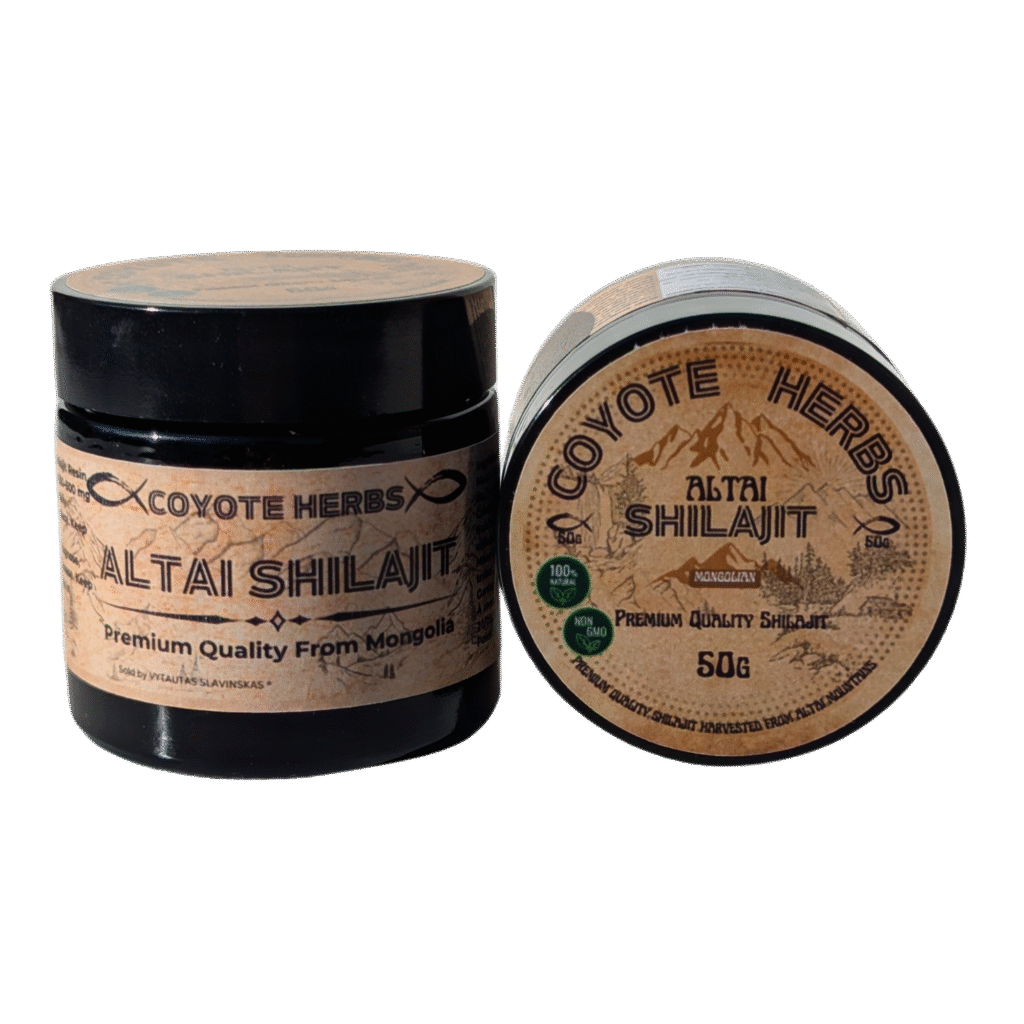
The short answer: keep shilajit resin in its original glass jar with the lid screwed on tightly, in a cool, dry and dark cupboard away from the stove, radiators, sunny windowsills and bathroom steam. Always use a clean, dry spatula. Shilajit resin naturally turns firm when it is cold and soft and sticky when it is warm. That change in texture is a normal physical property of the resin, not a sign that something is wrong.
This guide explains what shilajit actually is, why its texture changes so much with the seasons, how to handle a sticky jar without making a mess, and the simple habits that keep the resin clean and in good condition for as long as possible.
What is shilajit?
Shilajit is a dark, sticky, resin-like substance that is usually described as seeping out of rock crevices in high mountain ranges in warm weather. It is found in the Himalayas and in other mountain regions of Central Asia, including the Altai mountains. In Russian and Central Asian traditions it is better known as mumijo or mumio, and you will also see spellings such as shilajeet or salajeet.
Its exact origin is still discussed, but the most widely described explanation is that it forms over very long periods from plant material that has been broken down and compressed between layers of rock. Scientific reviews describe it as a complex mixture in which humic substances, including fulvic acids, are major components, together with mineral matter from the surrounding rock (see the review by Agarwal et al. in the sources below).
Raw shilajit collected from the rock contains sand, stone and other debris, so it is cleaned before sale. The purified result is the glossy, black-brown resin you find in a jar. Our own Altai shilajit resin comes from the Altai region and is supplied in a glass jar as a cosmetic raw material for external use. If you want to read more about its origin, see our article Altai Shilajit: The Biogenic Mineral Complex.
Why does shilajit resin change texture?
The most common question about shilajit is some version of “why is my resin rock hard?” or, in summer, “why has it turned runny?”. Both are normal.
Cold makes it firm
Like honey, tar or pine resin, shilajit is a very thick, viscous material whose consistency depends strongly on temperature. In a cool room, or after a winter delivery, the resin can feel as hard as a piece of dark toffee. You may not be able to push a spatula into it at all. Nothing has been lost; the resin has simply stiffened.
Warmth makes it soft and sticky
In a warm room, near a heater or in summer, the same resin softens and becomes stringy and very sticky. A jar left in a hot car or on a sunny windowsill can turn almost syrupy. Again, this is a physical change. Once the jar is back in a cooler place, the resin firms up again.
Why texture varies from jar to jar
Because shilajit is a natural material, two batches will never be identical. The moisture left after purification, the source rock and the season of collection all influence how firm or soft a particular resin feels. A batch that is slightly softer or firmer than your last one is not, on its own, a quality problem.
How to store shilajit resin: step by step
- Keep it in the original glass jar. Glass does not react with the resin and is easy to keep clean. Avoid moving it into thin plastic tubs or metal tins.
- Close the lid tightly after every use. An open jar collects dust and can take up moisture from the air, especially in a humid kitchen or bathroom.
- Choose a cool, dry, dark place. A kitchen cupboard away from the oven, or a drawer in a bedroom, works well. Avoid windowsills, radiators, the top of the fridge (warm air rises from the back) and the bathroom.
- Use a clean, dry tool every time. Wet spoons or fingers introduce water and debris. Use a small spatula or spoon that you keep only for the resin and dry it properly after washing.
- Keep the rim clean. If resin builds up on the thread of the jar, the lid will no longer seal well and can become stuck. Wipe the rim with a dry paper towel before closing.
- Label the jar if you decant. If you move a small amount into a separate container for convenience, write the product name and the date on it and keep the main jar sealed.
- Keep it out of reach of children and pets.
Can you put shilajit in the fridge?
You can, but it is usually unnecessary. A normal cool cupboard is enough. In a very hot flat in summer, the fridge can stop the resin from turning runny. Be aware that it will become very hard, and that a cold jar brought into a warm room collects condensation. Let the closed jar return to room temperature before opening it, so water does not drip onto the resin.
Should you freeze it?
There is no practical reason to freeze shilajit resin. Freezing makes it extremely hard and brittle, and repeated freezing and thawing encourages condensation inside the jar.
Handling tips for a jar that is too hard or too sticky
If the resin is too hard
Gently warm the closed jar. Hold it in your hands for a few minutes, or stand it in a bowl of warm (not hot) water for a short while, keeping water away from the lid. The surface will soften enough to take a small amount with a spatula. Do not microwave the jar or heat it directly on a stove: strong heat can crack glass and is unnecessary for a resin that softens at warm room temperature.
If the resin is too sticky
Put the closed jar somewhere cooler for a while, for example in the fridge for ten to fifteen minutes, then let it stand closed for a moment before opening. Cooler resin is much easier to portion. A spatula dipped briefly in cold water and then wiped dry will also release the resin more cleanly than a warm one.
Cleaning up
Shilajit resin is largely water-soluble, so spatulas, bowls and surfaces clean up with warm water and a little washing-up liquid. It can stain light fabrics and porous surfaces, so work over a plate or a piece of baking paper.
What good-quality shilajit resin looks like
When you open a new jar, these are the features you can check for yourself:
- Colour: deep brown to black, often with a glossy surface.
- Texture: firm when cool and pliable when warm, as described above.
- Smell: earthy, smoky and slightly bitter. It is not a pleasant perfume and is not meant to be.
- Cleanliness: no visible sand, grit, hairs or mould.
- Label: a clear product name, origin, intended use, batch number and best-before date.
Because shilajit is collected from rock, careful cleaning and purification matter. A reputable seller should be able to tell you the origin and intended use of the product, and the label should state how it may be used.
How long does shilajit resin keep?
Always follow the best-before date and the instructions on the label. Treat that date as the guideline for a jar that has been stored closed in the conditions described above. After opening, clean tools, a tightly closed lid and a cool, dry cupboard are what make the real difference.
Signs that a jar should not be used include visible mould, a sour or clearly unusual smell that is different from the earthy smell it had when new, or contamination with water or foreign material.
Shilajit is also part of our Core Elements Bundle, together with black seed oil and salt. You can browse other raw botanical ingredients in our Pure Botanical & Topical Raw Materials category, and for another storage guide see how to store black seed oil.
Frequently asked questions
What is the best way to store shilajit resin?
Keep it in its original glass jar, tightly closed, in a cool, dry and dark cupboard away from heat, sunlight and steam. Use a clean, dry spatula every time.
Why has my shilajit gone hard?
Shilajit resin becomes firm when it is cold. This is a normal physical property. Warm the closed jar gently in your hands or in a bowl of warm water and it will soften again.
Why is my shilajit runny or very sticky?
Warmth softens the resin. Move the closed jar to a cooler place, or put it in the fridge for a short time, and it will firm up.
Do I need to keep shilajit in the fridge?
Usually not. A cool cupboard is enough. In a very hot room the fridge can help, but let the closed jar return to room temperature before opening it to avoid condensation.
Is mumijo the same as shilajit?
Yes. Mumijo (also spelled mumio or mumiyo) is the name commonly used in Russia and Central Asia for the same type of mountain resin that is called shilajit in South Asia.
Please note: This article is general information about the origin, texture and storage of shilajit resin. Our shilajit is sold as a cosmetic raw material for external use only. Not a medicine. This information is not medical advice and the product is not intended to diagnose, treat, cure or prevent any disease. Follow the label and any instructions on the pack, and keep out of reach of children.
Sources
- Agarwal S.P. et al. (2007). Shilajit: a review. Phytotherapy Research (PubMed ID 17295385).
- Wikipedia, Shilajit