
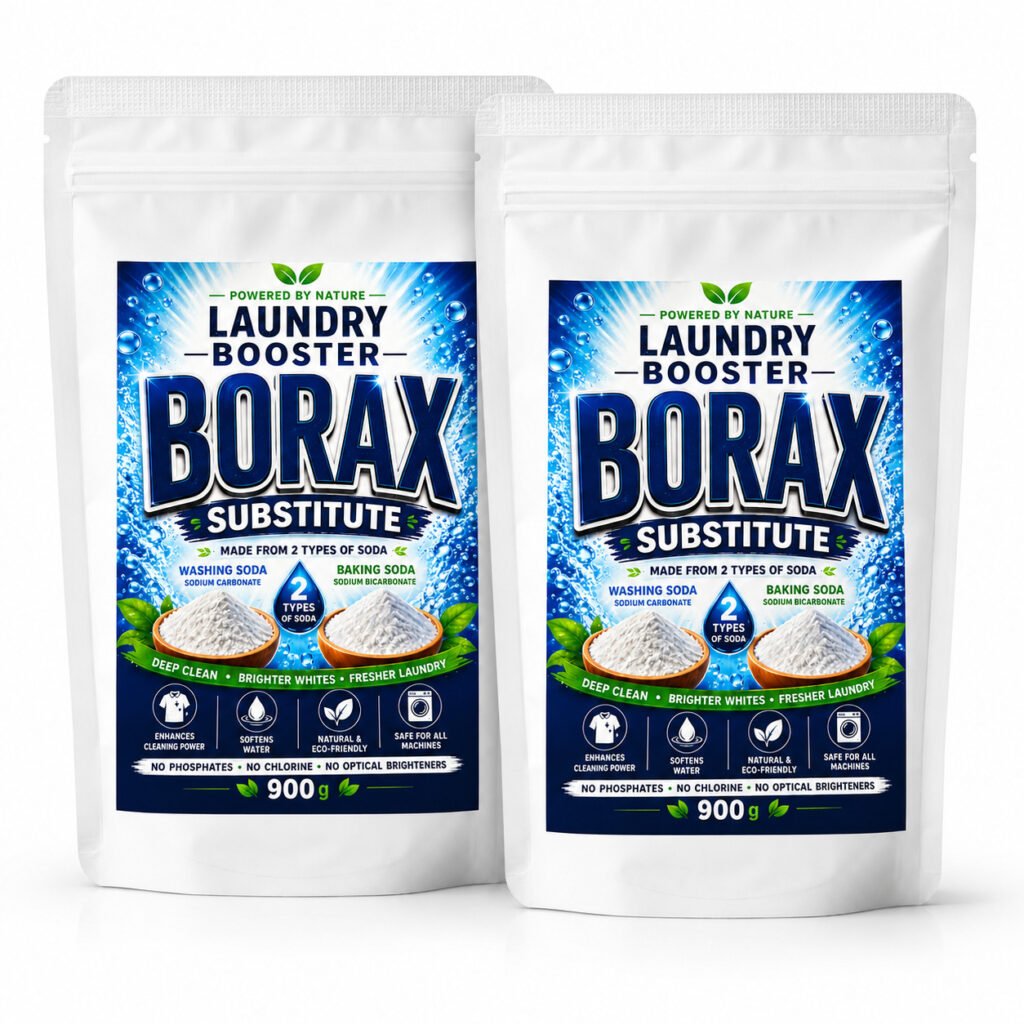
The short answer: washing soda (sodium carbonate) and baking soda (sodium bicarbonate) are two simple sodium salts that have been used around the home for generations. In the washing machine they work as a laundry booster: they make the wash water alkaline and help with hard water, so your regular detergent can do its job. Dose by weight, dissolve the powder properly, keep it away from wool and silk, and store it dry and out of reach of children.
Many people who once used borax in the laundry now look for a borax-free alternative made from soda. This guide explains what each of the two sodas does, how to use a soda-based booster in a washing machine or for a pre-soak, which fabrics to avoid and how to store the powder so it stays free-flowing.
Washing soda and baking soda: two different powders
Both powders are white, both are sodium salts and both are often sold side by side, so they are easy to confuse. In the laundry, however, they behave differently.
Washing soda (sodium carbonate, Na2CO3)
Sodium carbonate, also called washing soda or soda ash, is a strongly alkaline salt. It has a long history as a household cleaning agent and is used as a water softener in laundry: it reacts with the calcium and magnesium dissolved in hard water, so fewer of those minerals are left to interfere with the detergent. It is also good at helping to loosen greasy and oily soiling. Because it is strongly alkaline, it should be handled with some care (more on that below).
Baking soda (sodium bicarbonate, NaHCO3)
Sodium bicarbonate is the same baking soda many people keep in the kitchen cupboard. It is only mildly alkaline and much gentler than washing soda. In the laundry it is mostly appreciated for helping with everyday odours and for its gentle cleaning action.
Why blend the two?
A blend combines the stronger water-softening and degreasing action of washing soda with the milder character of baking soda. Our Borax Substitute Double Pack has a simple, fully declared composition: 55% sodium bicarbonate and 45% sodium carbonate, and nothing else. It contains no phosphates, no chlorine and no added fragrance, and the 1800 g double pack is portioned for about 60 washes.
What “hard water” means for your laundry
Water is described as “hard” when it contains a lot of dissolved calcium and magnesium. These minerals react with soap and some detergent ingredients, so part of the detergent is used up before it reaches the dirt. Typical signs of hard water at home are limescale in the kettle, white marks on taps and shower glass, and towels that feel stiff after drying.
If you see these signs, adding a soda-based booster to the main wash is a simple way to help your usual detergent. You can ask your local water supplier about the hardness of your tap water.
How to use a soda laundry booster in the washing machine
The quantities below are taken from the label of our Borax Substitute. Always check the care label on your garments first.
As a booster with your regular detergent
- Put your normal dose of detergent in the drawer or drum as usual.
- Add about 30 g (roughly 1.5 tablespoons) of the soda blend to the main-wash compartment.
- Select the programme recommended on the garment care label and wash as normal.
On its own, for a fragrance-free wash
For lightly soiled everyday cottons, the label suggests using 30–45 g of the blend on its own in the main-wash compartment. Use the higher amount for a fuller drum or harder water. Without a detergent there is no added scent, so the washing simply smells clean rather than perfumed.
A pre-soak for whites and dingy cottons
- Dissolve 30 g (about 2 tablespoons) in 4 litres of warm water in a bucket or basin and stir until the powder has dissolved.
- Submerge white or light-coloured cotton items, such as tea towels, bed linen or towels.
- Leave them to soak for 30 to 60 minutes.
- Transfer them to the washing machine and run a normal wash cycle.
Wear household gloves if you put your hands into the soaking solution, and rinse your hands afterwards.
What about vinegar?
Some people like to add 50–100 ml of white vinegar to the fabric-softener compartment, which is dispensed during the final rinse, while the soda goes into the main wash. Keep them in separate compartments: vinegar is an acid and soda is alkaline, so if you pour them together they fizz and neutralise each other before they reach the laundry. Check your washing machine manual before adding vinegar.
Fabrics and situations to avoid
An alkaline booster is best suited to cotton, linen and sturdy synthetic fabrics. As a general rule, do not use it on:
- wool, silk, cashmere and other animal fibres, which are protein fibres and should be washed with a product made for delicates;
- garments whose care label says hand wash only, dry clean only or “do not use alkaline detergents”;
- items with delicate trims, leather or metal details;
- brightly coloured items you have not tested before: try the pre-soak on a hidden seam first.
Never mix soda products with chlorine bleach or other household chemicals in the same container. Use one product at a time and follow each label.
How to store washing soda and baking soda
Both powders attract moisture from the air. Damp powder does not go “off”, but it can form hard lumps and becomes harder to measure. A few simple habits keep it free-flowing:
- Keep the pouch sealed. Press out the air and close the resealable zip after each use, or decant the powder into a dry jar with a tight lid.
- Store it somewhere dry. A cupboard is better than an open shelf above the washing machine or next to a tumble dryer, where the air is often warm and humid.
- Use a dry scoop. A wet spoon is the quickest way to create lumps.
- Label it clearly if you decant it, and never store it in a food container where it could be mistaken for baking ingredients or sugar.
- Keep it out of reach of children and pets.
If the powder has formed lumps, break them up inside the closed pouch with your hands, or dissolve the lumps in warm water before adding them to the wash.
Safe handling
The product label states that sodium carbonate causes serious eye irritation. Avoid getting the powder or solution in your eyes, wash your hands after handling it, and keep it out of reach of children. If it gets into the eyes, rinse cautiously with water for several minutes and follow the first-aid instructions on the label. This is a household cleaning product: it is not for eating or drinking and is not intended for use on the body.
You can find the booster together with other household and craft supplies in our Technical Grade & Home Craft Essentials category, or browse the whole Coyote Herbs shop. Delivery within Lithuania is free.
Frequently asked questions
What is the difference between washing soda and baking soda?
Washing soda is sodium carbonate, a strongly alkaline salt used as a water softener and degreaser in laundry. Baking soda is sodium bicarbonate, which is only mildly alkaline and much gentler. A laundry booster blend combines the two.
How much soda laundry booster should I use per wash?
For our Borax Substitute the label suggests about 30 g (roughly 1.5 tablespoons) as a booster with your regular detergent, or 30–45 g when used on its own. Always follow the garment care label.
Can I use washing soda on wool or silk?
No. Wool, silk and other animal fibres are protein fibres and should be washed with a product made for delicates, not with an alkaline booster.
Can I mix washing soda and vinegar?
Not in the same compartment. Vinegar is acidic and soda is alkaline, so mixed together they neutralise each other. If you use vinegar, put it in the fabric-softener compartment so it is dispensed during the rinse.
Why has my soda powder gone hard?
Both sodas absorb moisture from the air. Keep the pouch tightly sealed in a dry cupboard and always use a dry scoop. Lumps can be broken up by hand or dissolved in warm water.
Does the Borax Substitute contain borax?
No. Its declared composition is 55% sodium bicarbonate and 45% sodium carbonate.
Please note: this is a household cleaning product, not a medicine and not a food. This article is general household information only. Do not swallow it and do not apply it to the skin. If you have health questions, consult a doctor, especially if you are pregnant, breastfeeding, taking medication or have a health condition. Always follow the instructions and safety information on the product label.
Sources
- Product label of our Borax Substitute Double Pack: composition, dosage, soaking instructions and safety information.
- Wikipedia, Sodium carbonate (washing soda, use as a water softener in laundry)
- Wikipedia, Sodium bicarbonate (baking soda, properties and household uses)
- Wikipedia, Hard water (calcium and magnesium, effects on soaps and detergents)